

Do Biometrics Signals Change Based on Cognitive Tasks, and Can Gamification in Surveys Mitigate Cognitive Burden?

The survey gamification dataset includes physiological signals from 13 volunteers captured by two wearable devices: Empatica E4 and Samsung Galaxy Watch4, across two sessions, in three experimental conditions:

Each participant completed two sessions, spaced two weeks apart, with a structured experiment flow:
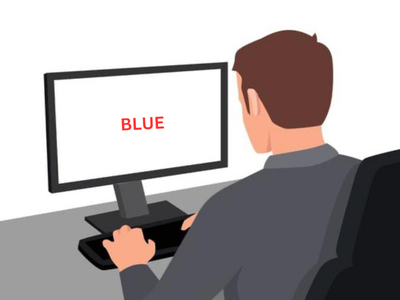
  1. Perform a cognitive task (Stroop Test).
  2. Rest and do not perform any tasks (Baseline).
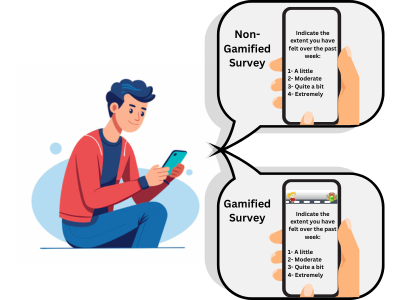
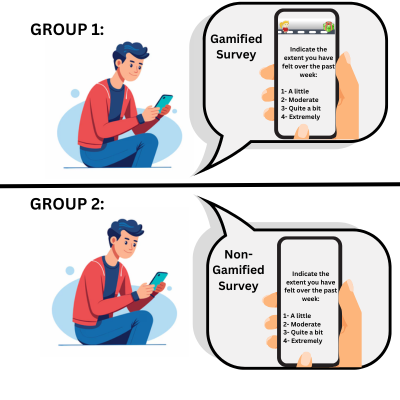
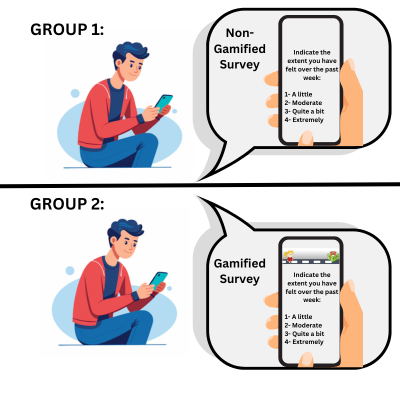
  3. Complete four work and well-being surveys (GRIT, PANAS, HAPPINESS, and NFR) in either a gamified or non-gamified format.
Participants were split into two groups: In our visualizations, you will be able to explore how different physiological signals vary under these conditions.
Scroll down to better understand the data and the options available for exploring it.

Understanding the Data

Click on a tab above to explore the different options for conditions, sessions, and devices.

Empatica E4 Wristband

The Empatica E4 is a wrist-worn, research-grade wearable and a Class IIa Medical Device designed for physiological monitoring. It measures key biometric signals, including:

  • Blood Volume Pulse (BVP): Used to derive Heart Rate Variability (HRV) and Inter-Beat Interval (IBI), providing insights into cardiovascular activity.
  • Electrodermal Activity (EDA): Captures skin conductance, reflecting emotional arousal and stress responses.
  • Skin Temperature (TEMP): Monitors changes in body temperature, which can indicate stress, activity levels, or environmental adaptation.

This device is widely used in research on cognitive load, stress, and emotional regulation. Understanding these signals will help in exploring their variations in different conditions.

Note: Some participants may have missing data due to unavailable recordings. As a result, certain data points might not appear in the visualizations for specific conditions. This is expected and does not indicate an error in the dataset.

Samsung Galaxy Watch4

The Samsung Galaxy Watch4 is a consumer-grade smartwatch running on Wear OS. It was used in this study to collect Photoplethysmogram (PPG) signals, which measure blood flow variations and can be analyzed to assess cognitive load.

  • Blood Volume Pulse (BVP): A PPG-derived signal that tracks changes in blood volume and heart activity. The Galaxy Watch4 captures PPG Green signals using the Samsung Privileged Health SDK.
The collected signal is stored and available for further analysis below.

Note:
  • Some participants may have missing data due to unavailable recordings. As a result, certain data points might not appear in the visualizations for specific conditions. This is expected and does not indicate an error in the dataset.
  • Unlike the Empatica E4, the Samsung Galaxy Watch4 only records Blood Volume Pulse (BVP).

Takeaways

Through interactive visualizations, we explored how different physiological signals respond to cognitive load conditions across multiple wearable devices. Our main takeaways are:

Our analysis provides insights into:

  1. Gamification Isn't Enough: Gamification, in its simplest form, does not appear to reduce the burden of self-reporting. Our data shows no significant differences in the biometric measurements (BVP, EDA, temperature) between the gamified and the non-gamified surveys. Elements of gamification more advanced than progress trackers may be required to reduce cognitive burden. Additionally, BVP measurements from the Empatica E4 and Samsung Galaxy Watch4 showed roughly similar distributions across conditions and survey types, despite using different measurement scales.
  2. Biometrics Not Sufficient: The physiological responses captured in the data do not greatly change across the Baseline, Cognitive Load (a.k.a Stroop Test) and Surveys (Gamified, Non-Gamified). This further informs us that these physiological measures may not fully capture cognitive burden. Future studies should integrate self-reported perceptions of burden to gain a more comprehensive understanding.
  3. By integrating real-time interactivity and smooth transitions, we've provided a dynamic tool for exploring nuanced, individual-level insights into the relationship between cognitive load and biometric data.